In the high-stakes reality of auto transport, multi-vehicle hauling presents steep challenges daily. Equipment reliability directly dictates your profit margins. Loading efficiency drives your operational success across state lines. Fleet operators constantly need smarter, more resilient engineering solutions. The 6-car configuration hits the ideal strategic sweet spot. It perfectly balances high payload capacity against necessary road maneuverability. Operators can comfortably haul a lucrative mix of heavy SUVs and standard sedans. This specialized setup minimizes fuel waste per trip significantly. It simultaneously maximizes overall revenue potential for independent carriers. This article serves as an objective, specification-driven guide. We will help you evaluate, configure, and source a reliable transport solution. We tailor these engineering insights specifically for heavy-duty B2B applications. You will learn about structural imperatives, fluid loading dynamics, and strict compliance realities. This vital knowledge empowers you to make smarter fleet purchasing decisions today.
Key Takeaways
Optimal Capacity & ROI: 6-car configurations (handling a mix of heavy SUVs and sedans) optimize the cost-per-unit ratio, especially when paired with dual-purpose (vehicle + container) adaptable decks.
Structural Imperatives: Long-term durability requires strict adherence to material benchmarks, such as high-strength Q345B carbon steel frames and accurately rated tandem/tri-axle setups (e.g., 13-ton axles).
Loading Dynamics: Advanced setups utilize drive-over belly decks, hydraulic ramps, and heavy-duty mesh floors to reduce turnaround times and protect vehicle suspensions via tire-strap tie-downs.
Compliance Realities: Maximizing a 48,000 lbs GVWR safely demands a Class 8 truck match, appropriate braking systems (air-over-hydraulic with ABS), and commercial licensing (CDL).
The Business Case: Why 6-Car and SUV Carrier Trailers Dominate Fleet Operations
Every commercial fleet operator desperately wants better fuel economics. A 6-space configuration mathematically reduces your operational costs per unit. Delivering six vehicles simultaneously splits fuel consumption efficiently. It cuts carbon emissions per delivered car sharply. Standard three or four-car haulers cannot match this consistent output. They consume too much fuel per vehicle moved. The strategic upgrade to a specialized SUV carrier trailer shifts operations into higher profitability. You can achieve intensive transport volumes while maintaining strict environmental compliance standards.
Operators absolutely need mixed-load versatility for securing high-margin freight. Dealerships demand faster deliveries of modern heavy luxury vehicles. You can combine heavy SUVs like Ford Expeditions and standard sedans easily. This mixed payload optimizes critical weight distribution across all axles. It prevents dangerous overloaded axle fines at state weigh stations. This diverse capacity caters to varied dealership demands perfectly. You never have to decline profitable oversized transport contracts again.
Empty returns drain your fleet profitability incredibly fast. Zero-revenue backhauls ruin excellent outbound shipping margins. Modern manufacturers combat this exact logistical problem directly. They introduce brilliant dual-purpose deck innovations. Some advanced designs combine an auto transport trailer frame with flatbed capabilities. You can haul luxury cars outbound and standard shipping containers inbound. This eliminates wasteful deadhead miles entirely. Dual-purpose solutions transform single-revenue routes into highly lucrative two-way logistics loops.
Engineering Benchmarks for Heavy-Duty Car Hauling Trailers
Long-term operational durability demands premium, uncompromising engineering choices. Standard mild steel severely limits heavy-duty fleet operations. You must prioritize high-strength carbon steel materials instead. High-grade Q345B steel absolutely dominates premium main beam construction. This specific alloy provides exceptional tensile strength. It handles massive twisting stress without suffering permanent deformation. Specific web and flange thickness directly prevents dangerous structural sag. Premium builds utilize a 500mm beam height for maximum rigidity. They feature a 14mm upper plate and a 16mm lower plate. Fully loaded configurations easily reach an immense 48,000 lbs GVWR. We strongly recommend verifying precise steel grades before signing any purchase contract.
Reliable commercial axle systems define your heavy haul capabilities. A commercial-grade car hauling trailer requires robust, unyielding mechanical support. We specify 13-ton commercial axles exclusively for heavy SUV loads. Standard 10-ton axles frequently fail under these extreme weights. Mechanical leaf spring suspensions provide proven, rugged durability. A specialized 90mm wide by 13mm thick 10-leaf configuration works best. It handles notoriously rough terrain effortlessly. These mechanical setups negotiate incredibly steep dealership ramps without failing.
Braking systems remain absolutely non-negotiable for driver safety. Max-capacity loads require serious, responsive stopping power. Commercial-grade air-over-hydraulic brakes represent the golden industry standard. Anti-lock Braking Systems (ABS) prevent catastrophic jackknifing incidents during panic stops. You must demand ABS technology on every single axle.
Component Category | Standard Fleet Specification | Heavy-Duty Carrier Recommendation |
Main Frame Material | Standard Mild Carbon Steel | High-Strength Q345B Steel |
Axle Weight Capacity | 10-Ton Standard Axles | 13-Ton Heavy Commercial Axles |
Suspension Mechanism | Basic Automotive Leaf Spring | 90mm x 13mm x 10-Leaf Setup |
Braking Technology | Basic Electric Brakes | Air-Over-Hydraulic (with active ABS) |
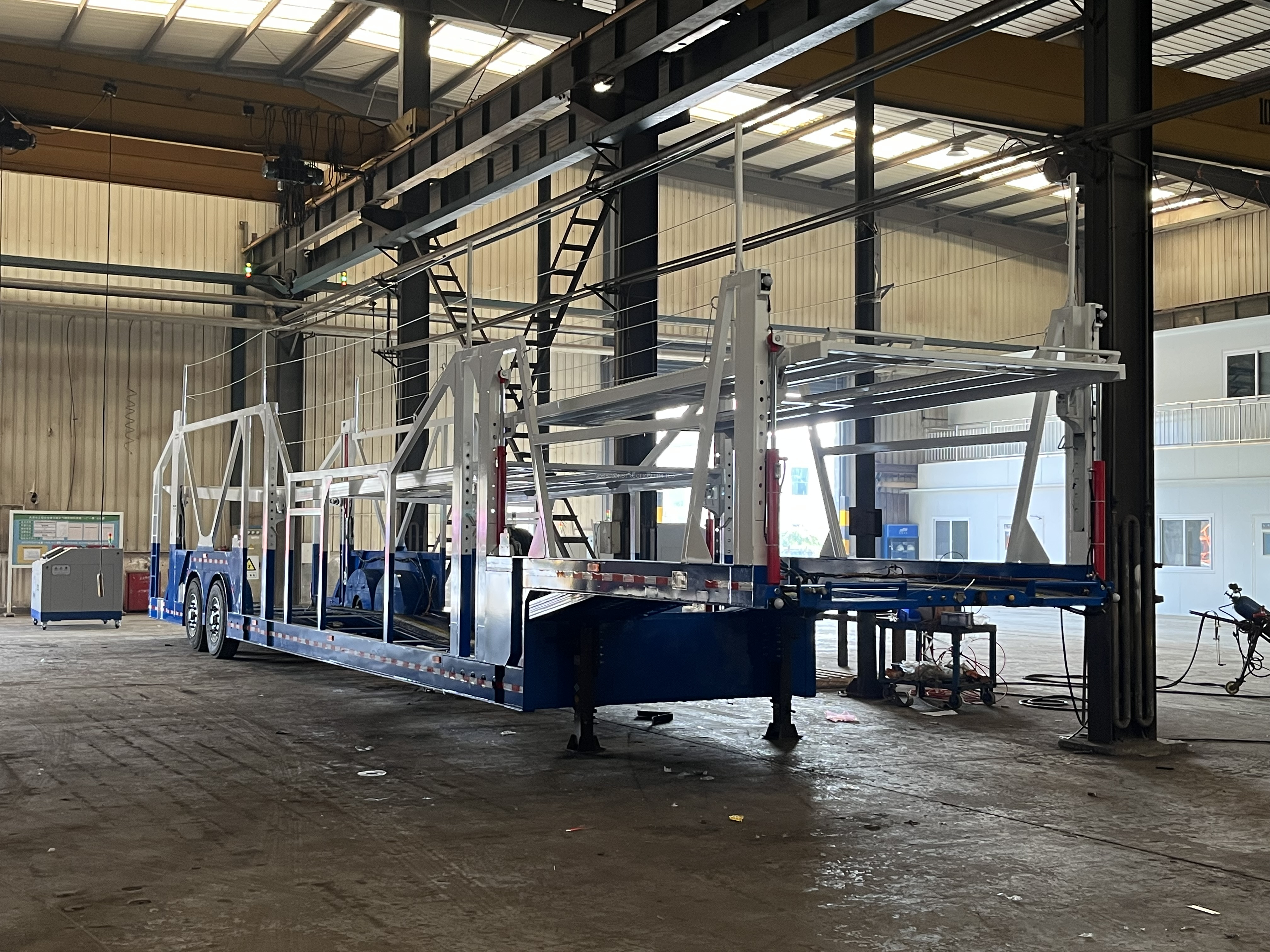
Loading Efficiency: Hydraulics, Deck Configurations, and Securement
Smart deck architecture drives substantially faster loading cycles. Drive-over belly decks speed up daily operations considerably. They allow drivers to position cars rapidly without complicated maneuvering. Flat upper decks offer straightforward, highly linear loading patterns. However, belly decks lower the entire center of gravity effectively. Tall SUVs require very specific headroom limits to avoid roof damage. Top manufacturers specifically design upper decks for 90-inch clearance. This precise measurement guarantees sufficient lower deck headroom for heavy vehicles.
Modern hydraulic systems successfully eliminate exhausting physical labor. Wireless remote-controlled hydraulic ramps improve loading flow drastically. Drivers adjust steep ramp angles safely from a secure distance. They avoid standing in dangerous mechanical blind spots. This reduces critical turnaround times at high-frequency delivery stops. A premium car transporter uses synchronized, heavy-duty hydraulic cylinders. They provide smooth, consistent elevation without dangerous jerking motions.
Securement methods prevent catastrophic, expensive cargo damage. You must protect delicate transported vehicle suspensions diligently. Traditional wheel-loop binding unfortunately applies severe lateral stress. We strongly advocate for installing heavy-duty mesh floors. They utilize specialized tire ratchet straps instead of wheel rings. This modern securement technique offers distinct structural advantages for any commercial vehicle transport trailer.
Direct Tire Binding: Allows the heavy vehicle suspension to travel naturally during transit.
Mesh Floor Integration: Offers infinite tie-down anchor points along the entire deck.
Reduced Damage Risk: Prevents blown air struts on expensive, high-end luxury SUVs.
Debris Management: Punched hole designs let snow and mud fall through easily.
Aligning the Vehicle Carrier to Your Operational Model
Choosing the correct trailer geometry defines your entire business scope. You must carefully align equipment to specific operational routes. High-Mount configurations deliver maximum structural rigidity. They offer immense flexibility for diverse, heavy cargo types. Conversely, Stinger or folding setups maximize tight volume constraints. Stinger trailers excel during high-frequency, congested urban operations. They maintain a lower overall height profile for city driving.
Route distances heavily dictate your ideal trailer footprint. You must choose intelligently between long-haul and home delivery layouts.
Long-Haul Interstate Routes: These require full-length 53-foot configurations. These long profiles dominate interstate highways and maximize freight capacity per mile.
Home Delivery Logistics: These require much shorter, highly maneuverable setups. They pair perfectly with Day Cab trucks for localized automotive eCommerce drop-offs.
Expandability represents a crucial, money-saving future-proofing strategy. Modern electric vehicles (EVs) possess uniquely long, heavy wheelbases. Oversized luxury SUVs constantly require extra structural support. Expandable trailer frames adapt seamlessly to these varying lengths. A highly versatile vehicle carrier handles evolving automotive designs. It prevents your expensive fleet equipment from becoming prematurely obsolete.
Compliance, Towing Requirements, and Risk Mitigation
Strict regulatory compliance prevents severe fleet operational penalties. Towing incredibly heavy loads requires proper, meticulous truck matching. A fully loaded 6-SUV transport semi-trailer carries immense weight safely. You absolutely need a robust Class 8 heavy-duty truck. Smaller chassis configurations severely compromise braking and steering dynamics. Pushing a highly loaded car carrier trailer with an underpowered rig invites disaster.
Hitching mechanisms dictate overall weight distribution fundamentally. Standard heavy-duty setups often use a reliable Fifth-wheel hitch. They handle massive payload transfers seamlessly across the truck frame. Alternatively, some unique configurations require high-capacity Gooseneck hitches. Goosenecks alter the pivot point dynamics noticeably during tight turns. We advise consulting engineering specs for proper hitch alignment.
Commercial licensing requires strict legal compliance everywhere you drive. You must fully understand Commercial Driver's License (CDL) mandates. Combining a heavy-duty truck, a massive steel trailer, and six SUVs creates immense mass. The Gross Combined Weight Rating (GCWR) easily exceeds standard legal limits. This strictly triggers mandatory CDL requirements in most jurisdictions. Furthermore, operators must carefully verify state-by-state height restrictions meticulously. High-profile loads constantly risk devastating bridge strikes without careful route planning.
Conclusion
Purchasing an auto transport solution remains a highly complex engineering decision. It is never just a simple capacity choice. Long-term fleet success relies on delicate structural balances. You must weigh steel quality carefully against hydraulic efficiency. Hitching compatibility directly impacts road safety and fleet compliance. Smart operators prioritize these precise technical parameters above base pricing.
Vendor selection criteria completely dictate your ultimate return on investment. We strongly advise buyers to seek direct-from-factory manufacturers. This avoids unnecessary, inflated middleman markups. You should demand rapid, transparent quoting processes always. Always verify long-term warranties on structural welds and commercial axles. Factory direct communication ensures accurate, reliable custom builds.
Now is the perfect time to optimize your fleet operations. Evaluate your current fleet's strict GVWR limits immediately. Assess whether your equipment handles modern heavy SUVs efficiently. Reach out today for a customized structural blueprint. Request a direct manufacturing quote tailored specifically to your business needs.
FAQ
Q: What is the required towing capacity for a fully loaded 6-car hauling trailer?
A: A fully loaded 6-car load pushes the trailer's Gross Vehicle Weight Rating (GVWR) up to 48,000 lbs. This extreme weight necessitates a dedicated Class 8 truck. Alternatively, operators can use a specifically geared heavy-duty chassis cab. Standard consumer pickups cannot handle this massive payload safely. You must ensure your towing vehicle strictly matches these commercial weight requirements.
Q: Can a vehicle transport trailer haul non-automotive freight?
A: Yes, you can transport non-automotive cargo safely. The trailer must utilize a dual-purpose flatbed or heavy-duty mesh deck. You must secure the alternative cargo properly. Operators must ensure heavy crates do not damage the sensitive hydraulic lift elements. This flexibility helps fleet operators eliminate expensive zero-revenue backhauls entirely.
Q: Do I need a CDL to operate a 6 SUV carrier trailer?
A: Yes, you absolutely need a Commercial Driver’s License (CDL) for almost all commercial applications. The combined weight of the towing vehicle, the heavy-duty trailer, and six vehicles matters. This total easily exceeds the strict 26,001 lbs threshold. Federal regulations strictly mandate a CDL for this heavy combined weight class.
Q: Steel vs. Wood deck: Which is better for a car transporter?
A: We highly recommend steel decks for commercial auto hauling. Specifically, heavy-duty mesh or punched hole steel plates offer superior longevity. They allow easy cleaning and provide infinite integrated securement points. Wood serves as a decent budget alternative initially. However, wood decks degrade quickly. They are significantly less ideal for frequent heavy SUV hauling.


