Fleet managers face a constant operational challenge every single day. They must balance maximum payload efficiency with rigorous safety and compliance standards in bulk liquid transport. Profit margins often shrink rapidly when outdated equipment fails to meet these demanding operational goals.
The 40,000-liter, three-axle configuration firmly stands out as the ultimate industry benchmark for regional and long-haul fuel distribution. It successfully offers massive bulk capacity while confidently navigating strict highway weight regulations safely.
This guide objectively evaluates how upgrading to an air suspension system impacts your bottom line, fleet safety, and long-term tank longevity for a high-capacity fuel tanker trailer. You will discover exactly how structural dynamics work, evaluate core material tradeoffs, and review essential safety architectures. We also provide a structured procurement checklist to help you optimize your next heavy-duty trailer investment.
Key Takeaways
Optimal Payload-to-Weight: A 40,000L capacity across three axles provides the ideal balance for meeting standard highway weight regulations while maximizing per-trip fuel transport volume.
Structural Longevity: Air suspension significantly reduces road shock, minimizing weld fatigue and stress cracks on the tank shell compared to mechanical leaf springs.
TCO Implications: While an air suspension tanker requires a higher initial capital expenditure (CapEx), it routinely offsets costs through reduced tire wear and extended trailer lifespan.
Safety & Stability: Integrated air suspension systems work dynamically with EBS/ABS to mitigate liquid surge risks and improve rollover thresholds.
The Business Case for the 40,000L Three Axle Configuration
Highway transport heavily relies on strict regulatory frameworks regarding gross vehicle weight ratings (GVWR). A standard three-axle truck and trailer combination typically hits its legal maximum weight right around 80,000 pounds or roughly 36,000 to 44,000 kilograms depending on regional laws. Because 40,000 liters of diesel weighs approximately 33,600 kilograms, this exact capacity keeps your fleet perfectly aligned with highway limits. Deploying a 40000L tanker avoids triggering expensive heavy-haul permit requirements.
Throughput economics heavily favor this exact volume. High-capacity transport fundamentally improves your return on investment. Drivers complete fewer trips per depot delivery. Less driving time reduces fuel consumption and minimizes driver fatigue. You maximize the delivery volume per single shift. This translates directly into highly favorable operational margins for long-haul fleet operators.
Operational flexibility remains just as crucial. Transport companies cannot rely solely on massive, unmaneuverable equipment. A three-axle configuration offers a surprisingly tight turning radius. This footprint maneuvers effectively in standard loading terminals. Drivers easily navigate commercial gas station drops in densely populated urban areas. It hits the sweet spot between maximum capacity and everyday usability.
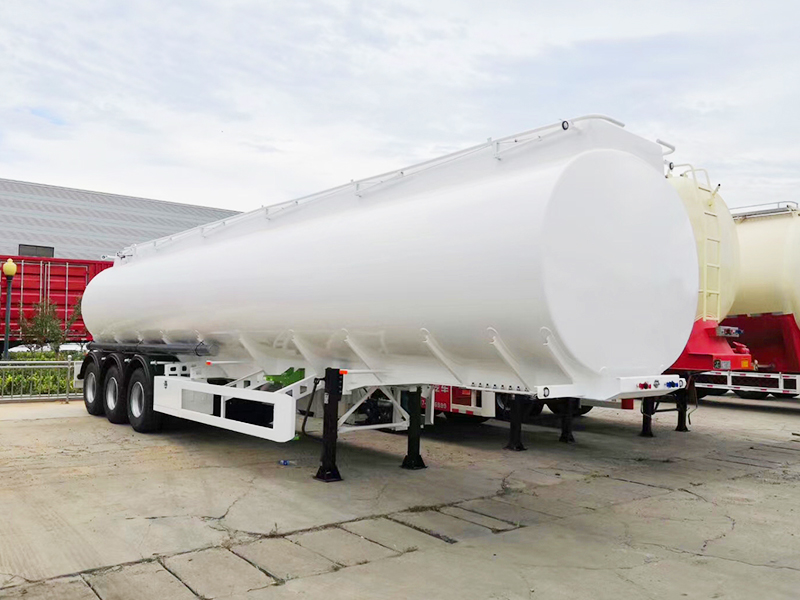
Air Suspension vs. Mechanical Springs in Liquid Tank Trailers
Bulk liquid transport behaves differently than dry freight hauling. We call this the "slosh effect." When a driver corners or brakes quickly, thousands of liters of liquid surge forward or sideways. Rigid mechanical springs struggle to handle this sudden weight shift. Pneumatic leveling valves inside an air suspension system solve this problem. They instantly detect pressure changes. They adapt to shifting weight distributions much faster than traditional leaf springs. This active adjustment dramatically improves vehicle stability.
Tank shell preservation represents another major engineering advantage. High-frequency road vibrations severely damage tank bodies over time. Continuous shaking causes micro-fractures in tank welds. These fractures pose severe risks when transporting hazardous materials. Air bags absorb these road shocks completely. Upgrading to an air suspension tanker actively prevents structural fatigue. This keeps your liquid tank trailer leak-free and compliant for years.
You must address the maintenance trade-offs transparently. Leaf springs offer extreme simplicity. They consist of stacked steel plates. However, air suspension systems introduce complexity. Maintenance teams must inspect air bags for dry rot. They need to check airlines for leaks. Compressor connections require regular service. You trade simple steel parts for intelligent pneumatic components.
Tire life extension often justifies this extra maintenance. Mechanical springs distribute weight unevenly across the three axles during hard braking. This causes severe tire scrubbing. Air suspension distributes weight perfectly across all tires. Fleet managers see a verifiable reduction in uneven tire wear. You replace tires far less frequently, saving significant operational funds annually.
Evaluating Tank Materials for a 40000L Tanker: Aluminum vs. Carbon Steel
Choosing the right tank material fundamentally alters your payload capacity. You must compare the exact curb weight. A 40,000L carbon steel tank typically weighs between 8,500 and 10,000 kilograms. An aluminum equivalent weighs roughly 6,000 to 7,000 kilograms. Aluminum's significantly lighter weight allows for marginally higher legal payloads. You haul more fuel and less metal on every single trip.
Corrosion resistance directly impacts fuel purity. Aluminum naturally resists rust completely. It prevents contamination without any extra help. This matters deeply when hauling sensitive products like aviation jet fuel. Carbon steel reacts poorly to moisture. Steel tanks require internal epoxy coatings to prevent rust. These coatings can chip or degrade over time. Degraded coatings risk contaminating diesel and petrol deliveries.
Capital expenditure (CapEx) versus long-term returns requires careful calculation. An aluminum oil transport trailer demands a much higher upfront purchase price. Steel remains noticeably cheaper initially. However, you recover the aluminum premium rapidly. You calculate the payback period based on daily fuel savings from towing a lighter empty trailer. You also factor in the extra revenue generated by higher legal payload limits.
Material Type | Average Tare Weight (40000L) | Corrosion Resistance | Upfront Cost | Payload Efficiency |
Aluminum Alloy | 6,000 - 7,000 kg | Excellent (Natural rust prevention) | High | Maximum legal payload |
Carbon Steel | 8,500 - 10,000 kg | Low (Requires epoxy coatings) | Moderate | Lower legal payload |
Core Safety Architecture and Surge Mitigation
Internal baffling systems serve as your primary defense against liquid surge. High-capacity tanks require specialized internal structures. Engineers install anti-wave plates inside the main vessel. These steel or aluminum dividers separate the interior into smaller compartments. Baffles control longitudinal liquid movement during sudden stops. Without them, a fully loaded tanker trailer could easily push the towing truck straight through an intersection.
Braking and stability integration pushes safety even further. Modern air suspensions pair directly with Electronic Braking Systems (EBS). They also utilize Roll Stability Support (RSS). These computerized systems constantly monitor wheel speeds and lateral acceleration. If the system detects an impending rollover, it automatically applies precise braking pressure to individual wheels. This active intervention saves lives on highway off-ramps.
Discharge systems and API standards govern terminal loading procedures. Modern depots require equipment to meet strict American Petroleum Institute (API) guidelines. Safe and rapid loading requires specific specialized components.
Bottom-Loading Systems: Operators connect hoses at ground level rather than climbing on top of the trailer. This prevents dangerous falls and minimizes static electricity generation during rapid fueling.
Vapor Recovery Valves: These critical valves capture hazardous fumes displaced during loading. They route vapors back into the terminal system, protecting terminal workers and the surrounding environment.
API Adapters: Standardized connection points guarantee compatibility across different global depots. They ensure a leak-proof seal, speeding up safe fuel transport turnarounds drastically.
Procurement Checklist: Shortlisting Your Oil Transport Trailer Manufacturer
Sourcing reliable heavy equipment demands strict vendor vetting. You must look far beyond the initial price tag. Manufacturers frequently cut corners on unseen internal components. Use this exact checklist to evaluate potential suppliers effectively.
Component pedigree determines long-term reliability. Buyers should rigorously verify axle and suspension brands. You want names you recognize. Insist on globally supported brands like BPW, SAF, or FUWA. Unbranded proprietary systems often lack replacement parts in remote regions. Name-brand components guarantee reliable performance across decades of harsh usage.
Welding and fabrication standards distinguish premium builders from cheap alternatives. Hand welding creates inconsistent seams. You must demand automated submerged arc welding for all main shell seams. This robotic process ensures perfect, uniform penetration. Additionally, ask for Non-Destructive Testing (NDT) certifications. Reputable builders use X-ray testing to prove hazardous liquid tanks have zero hidden structural voids.
Warranty coverage and local support dictate your future downtime. A comprehensive commercial warranty should strictly define its boundaries. You need to know exactly what fails.
Verify the warranty duration specifically covering main tank shell integrity and critical structural welds.
Confirm the exact replacement policies for high-wear suspension parts like rubber air bags and leveling valves.
Check local service center proximity to ensure immediate spare parts availability in your primary operating region.
Demand written documentation confirming the manufacturer will support the specific EBS/ABS electronic modules installed.
Conclusion
A 40,000-liter three-axle air suspension tanker ultimately represents the definitive choice for modern transport fleets. It perfectly aligns payload maximization with strict highway regulations. The advanced pneumatic suspension significantly dampens road shock, ensuring your expensive tank shell survives millions of miles without catastrophic weld failures. Aluminum material upgrades further secure your investment through natural corrosion resistance and higher legal cargo limits.
Procurement teams must take immediate, data-driven action. We strongly encourage you to request detailed weight distribution schematics directly from your shortlisted manufacturers. Demand comprehensive component spec sheets covering axles, braking modules, and API valve connections. Use these exact technical figures to run precise cost-efficiency calculations based on your specific regional routes and terrain conditions.
FAQ
Q: How much does a 40000L fuel tanker trailer weigh empty?
A: The empty tare weight varies heavily based on the main construction material. An aluminum three-axle tanker typically weighs between 6,000 and 7,000 kilograms. A standard carbon steel alternative is significantly heavier, usually weighing between 8,500 and 10,000 kilograms. Aluminum maximizes your legal payload capacity.
A: Yes, especially for high-mileage or hazardous materials transport fleets. The break-even point occurs surprisingly fast. You save substantial money through drastically reduced tank weld repairs. The system extends overall tire life evenly and prevents costly vibration-induced electrical faults across the entire trailer chassis.
Q: Can a three-axle fuel transport trailer be customized for rough terrain?
A: Yes, customization is entirely possible. While air suspension excels on paved highways, fleets operating primarily on unpaved roads or severe off-road conditions require different setups. Manufacturers can install heavy-duty mechanical leaf spring suspensions and extensively reinforced chassis designs to survive harsh environments.


