Acquiring a heavy transport asset represents a strategic business decision. It directly dictates your ability to bid on lucrative heavy machine transport contracts. A properly specced trailer unlocks high-margin logistics projects. Conversely, under-speccing creates serious operational hazards. It leads to axle failures, rollover risks, and costly compliance violations. Over-speccing traps vital capital and needlessly increases operational overhead. You need an optimal balance to protect your business margins.
This guide provides a purely objective, engineering-focused framework. We evaluate technical specifications, match payloads, and analyze vital procurement strategies for an equipment transport trailer. You will learn how to verify structural integrity and select the exact configurations your fleet requires.
Key Takeaways
Height Compliance First: Cargo exceeding 10 feet typically requires the 800–1100mm deck clearance of a lowbed to avoid oversize permit fines.
Capacity Margins: Always mandate a 20% to 30% net carrying capacity buffer above your heaviest anticipated machinery.
Material Integrity: Look beyond initial price—long-term durability relies on strategic steel blending (e.g., combining 100K and 80K psi steel) to resist vibration and metal fatigue.
Configuration Dictates Logistics: The choice between fixed-neck and detachable gooseneck directly impacts loading turnaround times and the need for auxiliary crane rentals.
The Business Case: Why Equipment Transport Trailers Drive Fleet Profitability
Lacking the right heavy haul trailer forces fleets to outsource highly profitable oversized loads. You effectively cede market share to competitors. Controlling the appropriate asset internally ensures you capture full project revenue and maintain scheduling autonomy.
Navigating the 3-Tier Height Rule
Regulatory bodies enforce strict maximum height limits. Surpassing these limits triggers massive oversize permit fees. You must match your equipment to the specific cargo height tier.
Cargo ≤ 8.5 feet: Standard flatbeds suffice. They offer the simplest loading dynamics for standard freight.
Cargo 8.5 – 10 feet: Step deck trailers provide the optimal solution. They lower the main deck to accommodate medium-sized equipment.
Cargo 10 – 12 feet: A lowbed semi trailer is mandatory. The deck drops as low as 18 inches off the ground. This keeps your cargo strictly beneath the 14-foot federal or regional height ceilings.
Eliminating Auxiliary Costs
Intelligent configurations actively eliminate on-site auxiliary costs. Removable gooseneck (RGN) designs allow you to drive tracked machinery directly onto the deck. You completely remove the need for expensive heavy crane rentals at both origin and destination sites.
Core Structural Configurations: Lowbed vs. Lowboy Trailer Models
Industry terminology heavily influences the procurement process. You must define the distinction between common structural configurations to avoid costly purchasing errors.
Defining the Distinction
Fixed-Neck Lowbed: These models feature a lower upfront complexity and lighter tare weight. They require rear loading via heavy-duty ramps. They work best for standard heavy equipment.
Lowboy (RGN - Removable Gooseneck): These demand a higher initial investment. However, they allow machinery to roll directly onto the front of the deck. They are ideal for ultra-heavy or low-clearance tracked machinery.
Detachment Mechanisms
If you select an RGN, you must choose a detachment mechanism. Your choice impacts turnaround times and maintenance schedules.
Hydraulic Detachable: This system acts faster and provides an adjustable ride height. However, it requires higher maintenance. You must also install a dedicated pony motor or a wet kit on the tractor.
Mechanically Detachable: This system offers a lighter overall weight. It has fewer failure points over the long term. The trade-off is that it requires more manual operator intervention during loading.
Best Practice: Assess your daily loading frequency. If you execute multiple drops per day in tight environments, hydraulic mechanisms justify their maintenance needs.
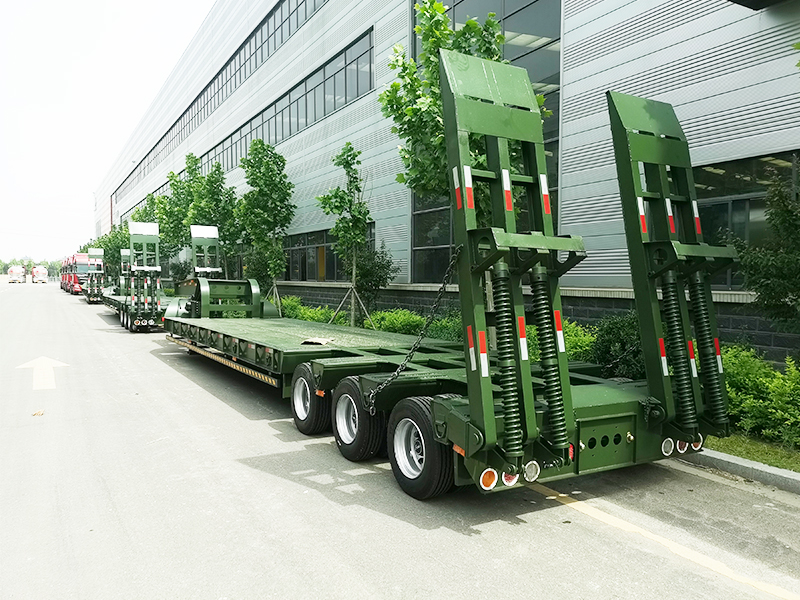
Axle Configurations and Net Carrying Capacity Matching
Accurate payload matching prevents catastrophic suspension failures. You must adopt a rigorous framework to determine the exact axle requirements for your fleet.
The 5-Step Capacity Matching Framework
Calculate the exact cargo gross weight. Do not rely on estimates.
Add the trailer's tare weight (empty weight) to find the gross vehicle weight.
Verify individual axle load limits against regional bridge laws.
Confirm road compliance for maximum dimensional restrictions.
Factor in the mandatory 20% to 30% safety redundancy margin.
Common Mistake: Failing to include the safety redundancy margin. Pushing a trailer to its absolute limit accelerates metal fatigue and severely degrades braking performance.
Typical Multi-Axle Lowbed Matrices
We rely on standard matrices to categorize payload classes. Use the chart below to match your cargo to the appropriate multi-axle lowbed configuration.
Axle Configuration | Capacity Margin | Typical Equipment Application |
3-Axle Platforms | 40 Tons | Standard bulldozers, mid-size excavators, agricultural machines. |
5-Axle Platforms | 60 Tons | Heavy industrial machinery, large wheel loaders. |
Modular/Extendable (7+ Axles) | 80–100+ Tons | Wind turbine components, specialized mining equipment. |
Evaluating Manufacturing Quality: What You Can’t See Matters
Surface appearance reveals very little about a trailer's true capability. You must investigate the engineering standards beneath the paint.
We warn operators against trailers built entirely from uniform, rigid steel. The best manufacturers implement mixed-yield builds. They combine a 100,000-psi web for extreme bending resistance with an 80,000-psi flange for vibration flexibility. This precise engineering synergy prevents severe stress fractures during transit over harsh terrain.
Main Beam Specifications
The main beam serves as the spine of the unit. You should detail the baseline specifications for heavy-duty performance. Expect a main beam height of at least 500mm and a width of 300mm. The side beams must feature reinforced 10mm steel to survive intense lateral forces.
Anti-Corrosion Protocols
Evaluate factory surface treatments closely. Paint sprayed directly over raw steel will flake within a year. We recommend shortlisting manufacturers utilizing thorough shot blasting followed by zinc-rich primer baking. For extreme environments, demand full-body hot-dip galvanizing. This advanced process secures up to 10 years of reliable rust prevention.
Suspension Systems and Cargo Stability Protocols
Choosing the correct suspension directly impacts the safety of your payload. The dynamic forces placed on a low bed trailer require strategic dampening.
Matching Suspension to Application
Rigid Suspensions: These are best for ultra-heavy, slow-moving loads. You generally operate them at speeds of 3–4 km/h. They provide ultimate stability and protect delicate internal truck components during massive pulls.
Air/Pneumatic Suspensions: These systems perform better for highway speeds. They offer excellent load equalization across all axles. They also isolate sensitive electronic equipment from road shock.
Physics of Heavy Machine Transport
Managing the physics of a loaded trailer dictates your safety protocols. Always prioritize lowering the center of gravity. Transporting tall machinery upright increases rollover risk exponentially.
You must use dunnage, such as wood friction mats, to increase deck friction. Steel machinery tracks on a steel deck will slide under hard braking. Finally, enforce strict center-symmetrical alignment during loading. This prevents uneven axle loading and drastically reduces rollover risks on uneven terrain.
Procurement Strategy and Lifecycle Logistics
Procurement teams must evaluate the long-term logistical impact of their specifications. Strategic buying involves evaluating the trailer's physical attributes against global supply chain realities.
The Lightweighting Trend
Trailer tare weight directly limits your legal cargo payload. We observe a strong industry shift toward lightweighting. High-strength alloy steels can reduce a trailer’s empty weight by up to two tons. This reduction directly increases your legal payload capacity. It allows you to haul larger equipment without violating gross vehicle weight ratings, thereby maximizing revenue per trip.
International Shipping Considerations
If you import trailers, you must aggressively assess freight implications. Shipping methods drastically alter final delivery timelines and logistics. You can ship units fully assembled via Ro-Ro (Roll-on/Roll-off) vessels. Alternatively, many modern designs allow you to bolt off the gooseneck. This enables the manufacturer to fit the entire trailer into standard shipping containers. Utilizing containerized shipping drastically cuts global freight costs and simplifies port clearance.
Best Practice: Always request containerization options from your manufacturer during the initial quoting phase. The savings on transoceanic freight often cover the cost of vital trailer upgrades.
Conclusion
Sourcing the correct lowbed trailer requires balancing multiple engineering variables. You must carefully weigh tare weight, axle distribution, and steel elasticity against your operational capabilities. Failing to secure the right payload margins introduces massive safety risks.
We encourage procurement teams to audit their heaviest anticipated loads for the next five years. Use this data as your baseline. Consult strictly with manufacturers who provide transparent finite element analysis (FEA). Demand exact metallurgical specifications and detailed axle load calculations before quoting any new equipment.
FAQ
Q: What is the difference between a lowbed and a flatbed semi trailer?
A: The primary difference lies in the deck height. Flatbeds sit higher and are strictly limited to cargo under 8.5 feet tall. Lowbeds feature a double-drop deck design. This crucial engineering enables the transport of equipment up to 12 feet tall while remaining entirely street legal.
Q: How do I determine if I need a hydraulic or mechanical gooseneck?
A: Base this decision on loading frequency and cargo type. If you load and unload multiple times a day or operate in tight, uneven terrain, a hydraulic system is worth the investment. If drops are infrequent, mechanical models save weight and reduce upfront complexity.
Q: Why is my multi-axle lowbed wearing through tires so quickly?
A: Rapid tire wear usually points to factory misalignment of the beam. It acts as a scrub radius, eating tires. It can also result from overloading specific axles due to improper center-of-gravity placement during loading. Check your alignment and distribute weight symmetrically.
Q: Can a standard 3-axle low bed trailer haul a 50-ton excavator?
A: Generally, no. A standard 3-axle platform is rated for roughly 40 tons safely. Pushing it to 50 tons risks catastrophic suspension failure. It violates the standard 20-30% safety margin rule and likely exceeds legal per-axle weight limits in your region.


