Fleet efficiency and operator safety hinge on a single operational bottleneck. The unloading cycle dictates your daily throughput. Choosing the wrong trailer profile increases cycle times. It accelerates equipment wear. It also introduces severe rollover risks on soft ground. Daily hauling operations demand flawless logistics to remain profitable. Every minute your drivers spend backing up or waiting for a spotter reduces your profit margin.
Procurement officers and fleet managers face a complex equipment decision. Evaluating a side dump vs rear dump trailer requires balancing payload capacity against strict site-specific constraints. You must consider uneven terrain and tight space limitations. You must also account for changing material viscosity and weather conditions.
This guide breaks down the operational realities of both trailer types. We explore their unique structural trade-offs and revenue implications. We will show you how to spec the exact asset your fleet needs. You will learn to maximize daily productivity while keeping your operators safe.
Key Takeaways
Rear dump trailers offer maximum payload capacity and versatility for tight, confined dumping zones but require stable, level ground to prevent tip-overs.
Side dump semi trailers excel in rapid cycle times and safety on uneven terrain, discharging materials in a linear windrow rather than a single pile.
Site footprint dictates the choice: side dumps require drive-through clearance, while rear dumps require vertical clearance and backing space.
The optimal choice depends on a rigid evaluation of material type, haul distance, and operator experience.
Core Evaluation Criteria for Heavy-Duty Tipping Trailers
Equipment selection must align directly with your site logistics. We cannot evaluate trailers based solely on maximum tonnage. A massive payload capacity means nothing if you cannot unload the material safely. Fleet managers must clearly define the specific business problem they need to solve.
You should view your procurement decision through three primary lenses. We recommend using this structured evaluation framework before reviewing manufacturer specifications.
Site Topography & Stability: Assess the exact ground where your trucks unload. Is the surface highly compacted and perfectly level? Do your operators frequently face sloped, soft, or shifting gradients? Landfills and remote sites often lack stable footing.
Spatial Constraints: Look up and look around your staging areas. Do you see overhead power lines, low bridges, or roof structures? Are the turning radii incredibly tight? You must map out the physical footprint available for the entire rig.
Material Characteristics: Analyze the specific aggregate you haul daily. High-viscosity materials like wet clay stick to tub walls. Abrasive materials like riprap cause severe impact damage. Fine powders demand specific watertight seals to prevent highway loss.
Ignoring any of these three factors leads to costly operational delays. You might buy a trailer that your drivers refuse to use. Evaluate your worst-case scenarios first. Base your baseline requirements on the most difficult job site you currently service.
The Rear Dump Trailer: Versatility and Payload
Let us define how this traditional equipment operates. A rear dump trailer discharges material straight out the back. It uses a robust, multi-stage hydraulic hoist. This hoist lifts the front of the tub high into the air. Gravity then pulls the heavy load out through the rear tailgate.
These units offer distinct structural advantages for heavy hauling applications. They dominate many traditional job sites for several reasons.
They provide a significantly higher maximum volume per trip.
They deliver a higher payload capacity compared to lateral alternatives.
Operators can create highly concentrated, consolidated material stockpiles.
They remain incredibly versatile across general construction and tight demolition sites.
However, we must address their implementation risks and daily limitations. The lifting action creates a dangerously high center of gravity. This extreme height creates a massive rollover risk. Even slightly uneven ground can cause the trailer to tip sideways. High crosswinds further exacerbate this tipping hazard.
You also need strict vertical clearance. Operators absolutely cannot lift the tub under powerlines. Striking an overhead obstacle causes catastrophic damage. Furthermore, these trailers often require a dedicated spotter. Backing maneuvers increase your cycle time heavily. They slow down the overall pace of your hauling fleet.
Best Practice: Always ensure the ground is perfectly compacted and level before engaging the PTO. Monitor tire pressures religiously, as one soft tire can initiate a fatal lean during the lift.
Common Mistake: Rushing the unloading process on soft highway shoulders. Drivers who ignore minor ground slopes frequently cause expensive rollover incidents.
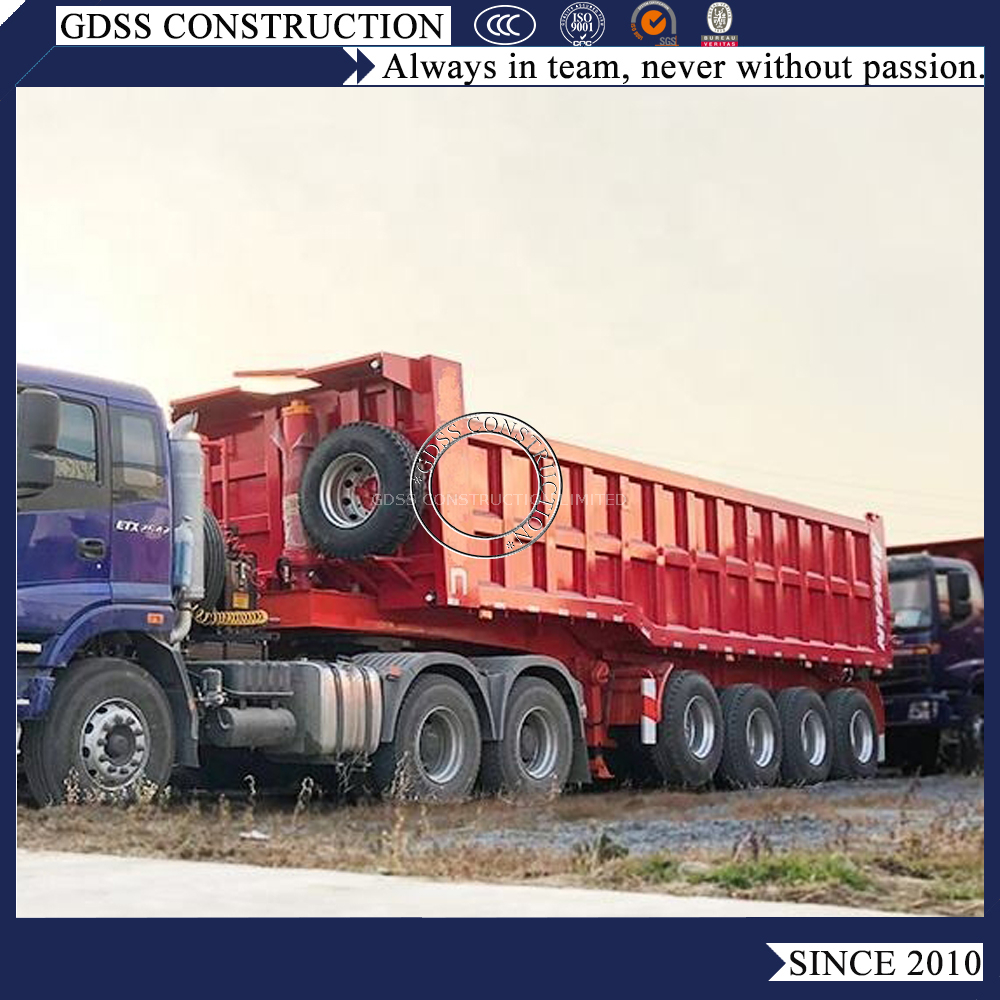
The Side Dump Semi Trailer: Cycle Speed and Operator Safety
A side dump semi trailer operates on a completely different mechanical principle. It hydraulically tilts the tub to the left or the right. The tub pivots smoothly off the main chassis. It deposits a continuous row of material alongside the trailer path.
These specialized units provide exceptional structural advantages. They thrive in fast-paced, open-environment hauling.
The extremely low center of gravity drastically minimizes any rollover risk. They remain stable even on steep, uneven gradients.
Operators perform "dump on the go" windrowing. This technique eliminates backing maneuvers entirely.
They significantly reduce unloading cycle times.
Watertight tub designs easily handle semi-liquids, wet sludge, and agricultural slurry.
Still, you must plan carefully for their specific implementation risks. They carry a slightly lower payload capacity. This reduction happens when compared to an equivalent-length rear-tipping model. The heavy hydraulic pivot mechanisms and reinforced tub edges add inherent tare weight. This extra steel eats into your maximum legal tonnage.
You also need a clear, extended linear path for unloading. These units lay material out in a long line. They are completely unsuitable for congested, single-point drop zones. If your hopper is small, lateral discharge will not work.
Best Practice: Train your drivers to maintain a slow, steady vehicle speed while discharging. This creates perfectly even windrows for the grading crew.
Common Mistake: Attempting to dump massive boulders without a properly lined tub. Standard steel bends under severe lateral impacts.
Side Dump vs Rear Dump Trailer: Head-to-Head Dump Trailer Comparison
Let us conduct a deep dive into operational metrics. A structured dump trailer comparison reveals where each unit excels. Understanding these distinct differences helps you optimize your daily operations.
Cycle Time & Throughput
Rear tipping models operate much slower during the final mile. The driver must arrive, turn around, and back in carefully. They wait for a spotter to verify clearance. They lift the tub, wait for the slide, and lower it. Finally, they pull out and leave. This rigid process takes several minutes per truck.
Lateral dumping moves noticeably faster. Drivers simply pull straight through the active drop zone. They dump their load while rolling forward. They never stop moving. They exit the site without ever engaging the reverse gear. This saves immense amounts of time over a ten-hour shift.
Maintenance & Wear
Traditional tipping units place intense stress on one single mechanism. The multi-stage hydraulic cylinder handles extreme vertical pressure. The rear hinge pins also take massive loads. Furthermore, tailgate latches require frequent cleaning. Mud and rocks jam the locking mechanisms easily.
Lateral models distribute wear much more evenly. They rely on multiple pivot points across the chassis. They use several smaller hydraulic cylinders. However, you must evaluate the tub wall thickness carefully. The tub walls absorb high-impact loads every single time you unload heavy rock.
Cost-Effectiveness & ROI
We evaluate CapEx versus OpEx differently for these two assets. Lateral units often carry a much higher initial purchase price. The complex hydraulics cost more upfront. However, they typically yield lower insurance premiums. Fleets experience drastically fewer rollovers. They also deliver faster throughput on large-scale jobs. Faster cycles mean more paid trips per day.
Feature | Rear Dump | Side Dump |
Unloading Direction | Backwards (Single pile) | Left or Right (Windrow) |
Rollover Risk | High (Elevated center of gravity) | Low (Tub stays near chassis) |
Payload Capacity | Maximum legal tonnage | Slightly reduced by heavy hydraulics |
Cycle Speed | Slower (Requires backing up) | Very Fast (Pull-through operation) |
Ideal Footprint | Tight, confined spaces | Open roads and wide sites |
Industry-Specific Applications: Where Each Trailer Wins
Different sectors demand completely different material handling strategies. You cannot apply a one-size-fits-all approach to heavy equipment procurement.
Mining & Aggregates
Selecting a mining dump trailer depends entirely on the pit layout. Lateral discharge models dominate haul road construction. They excel at building safety berms. They allow rapid stockpile expansion without stopping site traffic. Graders love following them because the windrows are pre-spread. Conversely, traditional tippers are retained for deep-pit operations. You need them when dropping ore directly into specific crusher hoppers.
Heavy Construction & Earthmoving
Traditional tippers completely dominate urban construction. They rule tight demolition environments. Space remains incredibly confined in inner cities. Materials must drop perfectly into existing excavation pits. Tight staging bays leave zero room for lateral discharge. A city job site rarely offers the drive-through clearance required for linear windrowing.
Agriculture & Material Handling
Lateral dumping is increasingly preferred across large agricultural operations. These units excel at hauling wet manure, heavy compost, and seasonal grain. Their watertight tubs prevent costly spills. You avoid leaving environmental hazards on public roads. Fast windrowing capabilities save farmers hours across massive open fields. They pull straight through the field without tearing up the topsoil with backing maneuvers.
Procurement Logic: Shortlisting Your Next Trailer
Buying the right asset requires a strict operational audit. You cannot base this massive decision solely on the lowest purchase price.
First, assess your current fleet compatibility. Ensure your existing prime movers have the correct hydraulic wet kit configurations. You need the exact pressure settings and fluid flow rates required by the new trailer. A standard two-line system might not operate complex lateral hydraulics efficiently.
Next, evaluate tare weight against local legal limits. You must factor the heavier chassis of lateral tippers into your math. Bridge laws and highway weight restrictions dictate your absolute maximum legal payload. A longer chassis distributes weight better, but it drastically alters your turning radius.
Do not ignore operator training requirements. Transitioning your fleet demands dedicated retraining programs. Drivers must learn new spatial awareness techniques in their mirrors. They must anticipate lateral load shifts during the exact moment of discharge. Dumping while moving requires coordination and practice.
Next Steps: Conduct a comprehensive site audit. Measure your most frequent unloading zones. Note the ground condition and overhead hazards. Complete this audit before issuing an RFQ to any commercial manufacturers.
Conclusion
Neither trailer profile is universally superior. The traditional tipper remains the undeniable king of confined-space payload. It maximizes your tonnage when vertical clearance is unrestricted. Meanwhile, the lateral tipper serves as the definitive choice for high-speed safety. It eliminates rollover risks on sloped, uneven terrain.
Base your final procurement decision on your most restrictive operational bottleneck. Identify if vertical clearance, poor ground stability, or strict cycle time limits hold you back. Let your worst-case daily scenario guide your capital allocation. Prioritize safety and cycle speed when operating on soft surfaces.
Contact our commercial fleet specialists today. We can help you run a detailed payload-to-cycle-time analysis tailored directly to your specific site conditions. Ensure your next asset purchase drives your operational efficiency forward.
FAQ
Q: Can a side dump semi trailer handle large boulders and riprap?
A: Yes, but the tub must be specifically lined (e.g., AR450 steel) to handle the lateral impact during unloading, whereas rear dumps often slide the material out with less localized impact.
Q: Are rear dump trailers cheaper to maintain?
A: Generally, yes, as they have fewer hydraulic cylinders and pivot mechanisms. However, the cost of a single rollover incident typically negates years of maintenance savings.
Q: How does bridge law affect dump trailer comparison?
A: Both trailers must comply with federal bridge formulas, but side dumps often feature a longer chassis to distribute their heavier tare weight, which can affect turning radius and maneuverability on tight sites.
Q: Do side dumps require specialized fifth-wheel setups?
A: Most operate on standard fifth wheels, but the tractor must be equipped with the appropriate hydraulic wet kit to power the multiple lateral cylinders.


