In high-yield harvest seasons, logistics bottlenecks do not happen in the field. They happen at the silo. Idle unloading time severely impacts fleet profitability. Combines must keep running to beat the weather, but they cannot operate if trucks are stuck in queues at the grain elevator. Every minute a truck waits to unload directly reduces your total daily hauling volume.
Enter the grain self dump tipper trailer. We introduce this asset as a targeted solution to minimize turnaround times. It maximizes daily haul cycles effectively. Relying on an internal hydraulic hoist means you do not depend on external facility infrastructure to empty your load.
Selecting the right equipment requires careful analysis. You must balance unloading speed against payload capacity, terrain stability, and structural reliability. In this guide, we will explore core mechanisms and material trade-offs. You will learn how to match trailer specifications precisely to your operational needs.
Key Takeaways
Self-dump tippers reduce silo turnaround times by eliminating the need for external unloading infrastructure.
Trailer material selection (aluminum vs. high-tensile steel) directly dictates the payload-to-weight ratio and long-term fatigue resistance.
Operational environments dictate the choice between rear-tip, side-tip, and alternative floor mechanisms.
Mitigating tip-over risks requires strict adherence to level-ground operation and specialized hydraulic maintenance.
The Role of Unloading Speed in Agriculture Logistics Profitability
Time is money during the peak harvest window. Every minute spent waiting at grain elevators cuts into fleet revenue. Idle time creates severe bottlenecks for fleet operators. When a truck waits an extra twenty minutes to dump its load, the ripple effects travel all the way back to the farm. Combines may have to stop. Field crews lose their momentum. This business problem highlights the hidden expenses of inefficient logistics.
You can measure your operational efficiency using "cycle times." A cycle covers the total duration from field loading to silo dumping and the return trip. Shorter cycles mean more loads delivered per day. To improve profitability, you must compress the dump phase of this cycle. Relying on facility infrastructure introduces variables you cannot control. Third-party augers break down. Drive-over pits get congested. Tipping platforms experience mechanical delays.
An agriculture logistics trailer equipped with a powerful hydraulic hoist offers a distinct competitive edge. It provides the "tipper advantage." Relying on internal hydraulic systems guarantees consistent, rapid discharge rates. You bypass facility-side delays completely. The driver pulls into the designated dump zone. They engage the power take-off (PTO). The load discharges in minutes. This self-reliance transforms unpredictable unloading queues into a tightly controlled operational metric. You gain the ability to forecast daily tonnage accurately.
Evaluating Dump Mechanisms: Rear-Tip vs. Side-Tip
Fleet managers must choose the correct dumping mechanism for their primary delivery sites. The wrong choice leads to structural damage or site incompatibility. Let us evaluate the primary options.
Rear-Tip Tippers
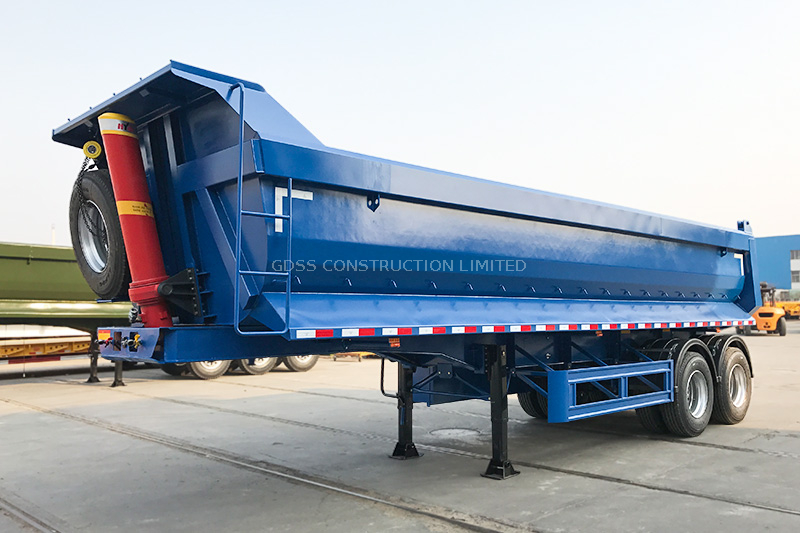
Rear-tip designs are the industry standard. They utilize a massive telescopic hydraulic cylinder mounted at the front bulk head. This cylinder raises the front of the box. Gravity forces the agricultural commodity out the rear tailgate. They are best for standard grain elevators. These facilities must offer adequate vertical clearance.
Pros: Rear-tips offer the fastest gross unloading speed. The steep angle ensures complete clean-out of the box.
Cons: They pose the highest risk of structural instability during maximum extension. A fully raised 40-foot box acts as a sail. It is highly susceptible to wind shear.
Side-Tipping Tippers
Side-tipping configurations use hydraulic rams mounted beneath the tub. They tilt the box laterally to discharge the load over the side. They are best for operations with severe height restrictions. They also excel at bunker silos. They allow for concurrent drive-and-dump processes. The driver can spread the load in a long windrow while moving slowly.
Pros: Side-tippers maintain a much lower center of gravity during operation. They are inherently safer on slightly uneven terrain.
Cons: They require longer dumping zones. You cannot back them neatly into narrow receiving hoppers. They also involve heavier tare weights due to the complex sub-frame structure.
Contrast with Alternatives
You should briefly compare tippers against other agricultural transport solutions. Walking floor systems feature moving floor slats. They discharge cargo horizontally. They discharge slower than tippers. However, they handle mixed-freight brilliantly. Hopper bottom or belly dump trailers rely purely on gravity. They require specialized drive-over pits. They cannot dump flat on the ground. Tippers offer the ultimate versatility for flat-pad discharging.
|
|
|
Dump Mechanism Comparison Table |
Mechanism Type |
Best Application |
Primary Advantage |
Main Limitation |
Rear-Tip |
Standard elevators, open pads |
Fastest unloading speed |
High rollover risk at max extension |
Side-Tip |
Bunker silos, low-clearance sheds |
Drive-and-dump capability |
Requires wide lateral dumping zone |
Walking Floor |
Indoor facilities, mixed freight |
Zero tip-over risk |
Slowest discharge rate |
Hopper Bottom |
High-volume drive-over pits |
Lightweight, fast gravity drop |
Requires specialized grates/pits |
Critical Evaluation Dimensions for a Grain Transport Trailer
When selecting a grain transport trailer, you must scrutinize three core dimensions. These dimensions separate premium assets from unreliable liabilities. They encompass material choices, hydraulic robustness, and commodity-specific features.
Material Selection: Payload vs. Durability
The body material dictates the fundamental payload-to-weight ratio. Aluminum maximizes your payload capacity. It is significantly lighter than steel. You can haul more bushels per trip legally. However, aluminum is rigid. It is susceptible to stress fractures. Rough agricultural terrain punishes aluminum frames over time. High-tensile steel presents an alternative. It has a heavier tare weight. You sacrifice some payload capacity. Yet, it offers superior durability. Steel absorbs the twisting forces encountered during field-to-highway transitions much better than aluminum.
Hydraulic System Reliability
The hydraulic system acts as the heart of your trailer. You must evaluate the cylinder stages carefully. A high-quality five-stage telescopic cylinder provides smooth lifting action. Check the operating pressure thresholds. Systems operating between 2,500 and 3,000 PSI offer optimal lifting force. Cold-weather fluid performance is equally crucial. Standard hydraulic fluids thicken in freezing temperatures. This sluggishness delays cycle times. Specify ISO 15 or synthetic multi-grade fluids if you operate in northern climates.
Grain-Specific Features
Agricultural commodities require specialized containment. Tarp systems protect the load from moisture. Automated electric roll tarps improve safety. The driver stays on the ground. Manual tarps cost less but increase injury risks. Tailgate sealing demands strict attention. Fine grains like canola or flax seed flow like water. They will leak through poor seals. Specify continuous rubber D-gaskets along the tailgate perimeter. Finally, consider grain door configurations. A secondary metered door within the main tailgate allows for controlled flow. This helps when filling smaller augers.
Implementation Realities and Operational Risks (E-E-A-T)
Deploying specialized equipment introduces new risks. You must manage these risks proactively. Ignoring safety protocols leads to catastrophic accidents. We will transparently assess the operational realities of tipping equipment.
Tip-Over Hazards
We must present a transparent assessment of rollover risks. Operating a fully extended bulk grain semi trailer demands extreme caution. The center of gravity shifts drastically as the box raises. A slight crosswind or uneven tire pressure can initiate a lateral roll. Once the roll begins, the driver cannot stop it. The torque will twist the tractor frame alongside the trailer.
Site Requirements
Site conditions dictate tipping safety. We emphasize the strict necessity for level ground. The dump pad must be compacted and firm. Soft mud allows trailer tires to sink on one side. This sinking creates an immediate tilt. Operators must also monitor wind speeds. You should establish strict operational thresholds. Many fleets suspend rear-tipping operations when sustained winds exceed 20 miles per hour.
Operator Training
Driver proficiency is non-negotiable. Operators require rigorous training before using tipping equipment. They must master load distribution. An unbalanced load clinging to the front bulkhead acts as a pendulum. Drivers need proficiency in PTO (Power Take-Off) engagement. Incorrect RPM settings damage hydraulic pumps. Furthermore, operators must understand emergency hydraulic overrides. They must know how to lower the box safely if primary controls fail.
Maintenance Assumptions
You must acknowledge hidden maintenance factors. Tipping trailers require more upkeep compared to non-tipping alternatives. Hydraulic wear happens daily. Hoses chafe. Seals degrade. Structural pivot-point maintenance is critical. The rear hinge pins support the entire load weight during the final dump stage. These pivot points demand weekly greasing. Failure to lubricate these pins leads to binding. Binding causes catastrophic structural tears in the aluminum or steel sub-frame.
Shortlisting Logic: Matching Trailer Specs to Your Fleet
Procurement requires careful alignment between equipment specifications and your operating environment. You cannot buy based on volume alone. Regulatory compliance and tractor compatibility drive the final decision.
Axle Configurations & Compliance
Regional bridge laws govern axle configurations. How do you choose between tandem, tri-axle, or 4-axle setups? You must analyze your local Gross Vehicle Weight Ratings (GVWR). A tandem axle suffices for standard highway limits in many regions. However, hauling heavy commodities over specific bridge spans often requires spreading the weight. Tri-axle setups reduce the load per axle. A 4-axle configuration maximizes legal payload in jurisdictions utilizing strict federal bridge formulas. Consult local transport authorities before finalizing axle spacing.
Volume vs. Density
Calculating cubic capacity needs requires understanding crop weight. You base trailer volume on the specific commodity density. Heavy commodities "weigh out" before they "cube out." Lighter crops do the opposite.
Consider the following chart summarizing typical crop densities. This HTML table chart illustrates why volume requirements shift drastically based on the harvest.
|
|
Commodity Density and Volume Chart |
Commodity Type |
Average Weight (lbs per bushel) |
Trailer Capacity Strategy |
Wheat |
60 lbs/bu |
Requires smaller cubic volume. Will hit legal weight limits quickly. |
Corn (Shelled) |
56 lbs/bu |
Requires medium cubic volume. Balanced payload mapping. |
Barley |
48 lbs/bu |
Requires larger cubic volume to maximize legal weight. |
Oats |
32 lbs/bu |
Requires maximum cubic volume. High walls are necessary. |
If you haul wheat exclusively, a massive high-sided trailer wastes money. The extra aluminum adds tare weight unnecessarily. Conversely, hauling oats in a low-sided trailer leaves potential revenue behind. Match the tub volume to your primary crop density.
Next-Step Actions
We recommend specific actions before procurement. Request vendor CAD drawings to verify swing clearances. You must ensure the tailgate does not strike your specific hopper grates. Verify hydraulic cycle times with the manufacturer. Ask for data proving the raise and lower durations. Finally, match tractor wet kit compatibility. Your truck's hydraulic reservoir must hold enough fluid to fill the trailer's multi-stage cylinder fully. A mismatched wet kit causes pump cavitation.
Conclusion
A self dump tipper serves as a high-efficiency asset only when correctly matched to the discharge environment. It must also align with your fleet capabilities. Unloading speed transforms logistics profitability, but only if executed safely. You reduce silo turnaround times drastically. You eliminate reliance on slow facility augers.
We advise buyers to prioritize hydraulic stability and regional payload compliance over raw volumetric capacity. A massive tub is useless if it exceeds bridge weight limits or poses severe tip-over risks. Durability and safety yield better long-term returns than sheer size.
Take action today. Audit your current silo turnaround times during the next harvest. Calculate the minutes lost waiting in queues. If idle time is draining your profit margins, contact a sales engineer. Request a route-specific trailer specification review. Proper equipment alignment will maximize your daily haul cycles.
FAQ
Q: How fast does a grain self dump tipper trailer typically unload?
A: Hydraulic cycle times vary based on PTO output and cylinder size. A standard 40-foot trailer typically raises fully in two to three minutes. Lowering takes approximately two minutes. Total discharge, including grain flow, usually completes within five to seven minutes.
Q: What is the maximum safe dumping angle for high-moisture grain?
A: High-moisture grain has a steep angle of repose. It tends to clump and stick to the tub walls. You often need 40 to 45-degree tipping angles to dislodge wet crops safely. Always ensure the ground is perfectly level before reaching these extreme angles.
Q: Can a bulk grain tipper be used for other agricultural commodities?
A: Yes, you can cross-utilize these trailers for fertilizer, feed, or root crops like potatoes. However, fertilizer is highly corrosive. You must wash the tub frequently. Root crops require heavy-duty floor materials. Ensure robust tailgate seals are installed for fine feed powders.
Q: How do side-tipping trailers affect axle weight distribution?
A: Side-tippers cause significant lateral weight shifts during the dump cycle. The load pushes down heavily on the tipping-side tires. This imbalance requires specialized heavy-duty suspension setups. The frame must withstand extreme torsional stress compared to rear-tipping models.


