Moving ultra-long, high-tonnage infrastructure components often triggers severe logistical bottlenecks for project managers. Project engineers frequently maneuver 30-meter to 60-meter bridge beams through unforgiving route geometries. Standard heavy-haul equipment consistently struggles under these extreme conditions. Rigid trailer structures cause poor turning radii and dangerously uneven axle load distribution on public roads.
Industry professionals solve these transportation problems using linked modular configurations. This specialized equipment utilizes front and rear bogies equipped with hydraulic turntables. They decouple the primary tractor from the rear load-bearing axles. This makes them the definitive standard for navigating extreme monolithic lengths through restricted public highways and tight construction access roads.
We provide heavy haulage contractors and logistics planners a highly technical framework here. You will learn how to evaluate, shortlist, and implement these advanced hauling systems for upcoming infrastructure projects. We explore payload distribution mechanics, critical steering algorithms, and route compliance requirements. Read on to master the complexities of hauling monolithic girders safely.
Key Takeaways
Linked trailer configurations decouple the tractor from the rear load-bearing bogie, allowing independent steering and dramatically reducing the required turning radius.
Selecting the right bridge beam trailer requires precise calculations of payload distribution, hydraulic stroke, and maximum steering angles.
Implementation success depends heavily on preliminary swept-path analysis and compliance with regional axle-load regulations.
Compared to extendable trailers or SPMTs, a linked trailer system offers a higher ROI for point-to-point highway transport of monolithic long materials.
Operational Bottlenecks in Bridge Beam Transport
Modern infrastructure demands increasingly larger precast concrete and steel elements. Hauling these massive components from fabrication yards to installation sites presents immense logistical hurdles. Standard transport methods frequently fail when pushed beyond 30-meter load lengths.
The Turning Radius Challenge
Rigid extendable trailers face severe physical limitations during transport. Navigating standard roundabouts, tight urban intersections, or narrow job-site access roads becomes impossible with 40-meter girders. A traditional telescopic trailer sweeps across multiple traffic lanes during a simple 90-degree turn. The rear axles follow the path of the tractor in a fixed geometry. This wide sweep forces contractors to remove street furniture, fell trees, or temporarily dismantle road signs. You lose valuable operational time and heavily increase project site preparation requirements.
Weight Distribution & Axle Limits
Concentrated loads from concrete or steel girders pose another major challenge. Monolithic bridge beams often weigh between 80 and 150 tons. Standard commercial trailers cannot support this immense point load without exceeding legal highway axle limits. Many jurisdictions restrict axle weights to 10 or 12 tons per line. Exceeding these regulations damages road surfaces and voids transport permits instantly. Heavy-duty transport requires modular axle configurations. You must spread the girder's deadweight across multiple hydraulic axle lines to remain strictly compliant.
Dynamic Stability Risks
Transporting ultra-long components introduces complex dynamic forces. A solid 50-meter steel girder essentially acts as the structural link between two independent trailer units. This setup amplifies physical forces significantly.
Wind Shear: Massive concrete side profiles act like sails. High crosswinds threaten lateral stability during highway transit.
Cambered Roads: Sloped road shoulders alter the center of gravity. You risk load shifting if the hydraulic suspension cannot compensate adequately.
Braking Inertia: Emergency braking sends massive kinetic energy forward. The tractor and rear bogie must sync perfectly to prevent the girder from breaking its lashing chains.
Core Mechanics of a Linked Trailer Train for Long Girder Loads
Engineers overcame rigid trailer limitations by fundamentally redesigning the transport architecture. The resulting system effectively turns the payload into an active part of the vehicle structure.
System Architecture
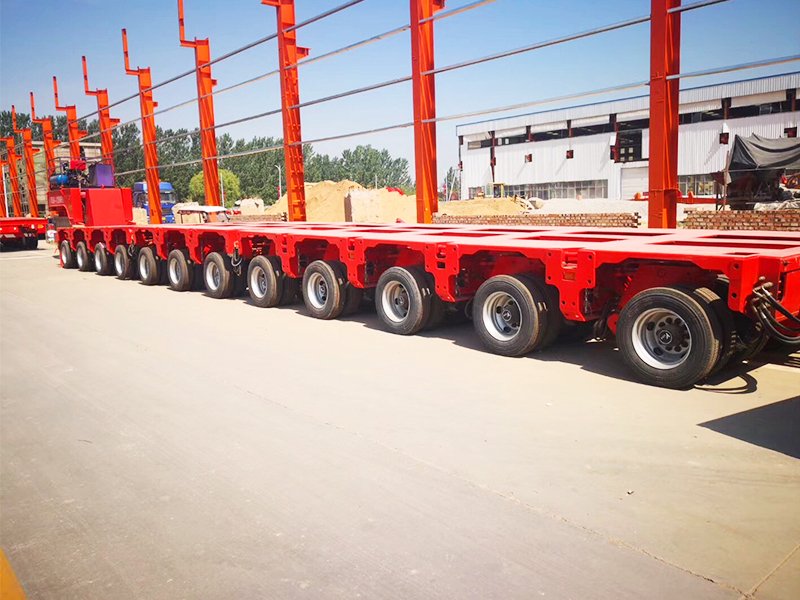
We must break down the physical setup to understand its efficiency. The primary tractor unit leads the convoy. It connects to a front dolly or modular bogie. A specialized front turntable sits atop this front module. The actual concrete or steel girder rests on this turntable. Crucially, the girder itself spans the gap and acts as the chassis spine. The rear of the girder rests on a secondary rear turntable. This rear bolster attaches to an independent rear steering bogie. This open gap design eliminates the deadweight of a massive steel trailer deck.
Hydraulic Turntables (Bolsters)
Load-bearing bolsters serve as the critical connection points. They allow the massive girder to pivot freely during turns. These specialized turntables transfer the girder's immense weight evenly across the hydraulic suspension below. As the tractor enters a tight corner, the front bolster rotates smoothly. This rotation prevents torsional stress from cracking precast concrete beams. High-quality turntables utilize automated locking mechanisms for straight highway cruising and free-pivoting modes for localized maneuvering.
Independent & Remote Steering
The rear load-bearing module dictates the overall agility of a girder transport trailer. It operates independently from the primary tractor. Operators manage this steering via mechanical linkage, hydraulic displacement, or wireless remote control. A secondary steersman frequently walks alongside the rear bogie. They use a remote console to crab-steer the rear module around incredibly tight corners. This active tracking allows the rear axles to follow the exact tire tracks of the front unit. It dramatically shrinks the required swept envelope.
Communication & Braking Lines
Decoupling the trailer sections creates a secondary engineering challenge. You must connect the front and rear modules safely. Operators deploy secure, extendable pneumatic and electronic umbilicals. These vital lines run directly along the side of the girder. They sync the air braking systems between the lead tractor and the rear axles. Telemetry cables also ensure the primary driver receives real-time hydraulic pressure data from the rear bogie. Snapping an umbilical line during transit triggers fail-safe emergency brakes instantly.
Evaluation Criteria for Selecting a Girder Transport Trailer
Procuring the appropriate equipment defines the safety and success of heavy transport operations. Logistics managers must scrutinize several technical parameters before mobilizing equipment for infrastructure megaprojects.
Payload and Axle Configuration
You must carefully match the module capacity to the specific deadweight of the bridge beams. Manufacturers typically offer 2-file or 3-file modular trailer configurations. Wider 3-file setups offer superior lateral stability for top-heavy loads. Evaluate the hydraulic suspension stroke meticulously. Advanced modular axles provide up to 600mm of vertical suspension travel. This compensation capability proves vital when navigating uneven terrain or climbing steep highway ramps. It keeps the girder's center of gravity perfectly level.
Best Practice: Always calculate the operational payload at 80% of the trailer's theoretical maximum capacity. This buffer accounts for dynamic shock loads encountered over rough highway surfaces.
Steering Angle and Maneuverability
Compare the maximum steering angles of the rear bogie across different equipment brands. Standard mechanical trailers might offer only 45-degree steering limits. Premium modular systems deliver 60-degree or even 65-degree hydraulic steering angles. High-angle steering remains absolutely critical for complex route geometries. A wider steering angle directly reduces the turning radius. It enables operators to navigate narrow toll booths, tight cloverleaf interchanges, and highly restricted job-site gates without extensive civil works.
Modularity and Fleet Integration
Heavy transport firms must maximize their existing asset utilization. Assess whether new turntables and bolsters can seamlessly retrofit onto your existing modular trailers. Industry-standard equipment, like THP/SL axle lines, often accepts aftermarket bolsters easily. This modularity allows you to convert standard heavy-duty platforms into a dedicated beam hauling system within hours. You avoid purchasing entirely new trailer systems for a single bridge project.
Safety and Redundancy
Catastrophic load shifting during transit presents the highest risk factor. Look strictly for dual-circuit hydraulic steering systems. If one hydraulic line ruptures, the secondary circuit maintains full steering control. Insist on fail-safe braking mechanisms. The rear bogie must feature spring-applied, air-released brakes. Examine the mechanical lashing points on the bolsters. They must feature certified tonnage ratings exceeding the longitudinal inertia of the transported girder.
Implementation Realities and Route Compliance
Owning the right equipment covers only half the logistical equation. Executing the actual move requires exhaustive planning, strict legal compliance, and extensive route preparation.
Swept Path Analysis (SPA)
You cannot estimate cornering capabilities by eye. Emphasize the strict necessity of 3D route simulation software. Engineers use SPA tools to map out the exact dynamic envelope of a long material transport train before mobilization. These simulations plot the path of every axle and the overhang of the girder. They identify potential collision points with guardrails, traffic lights, and bridge parapets. Completing an SPA prevents costly delays and emergency rerouting on the day of the move.
Permitting and Axle Load Regulations
Discuss transport laws with local authorities early in the planning phase. Regional laws vary wildly regarding maximum allowable axle weights. Most authorities require customized route permits for loads exceeding standard dimensions. Moving massive girders frequently dictates the necessity for specialized escort vehicles. Front and rear pilot cars manage civilian traffic. Police escorts may shut down intersections temporarily. Ensure all paperwork accurately reflects the exact axle configuration of your trailer setup.
Operator Training Requirements
Operating decoupled trailer configurations introduces a steep learning curve. The primary truck driver no longer controls the entire vehicle footprint. Highlight the critical need for seamless communication. The lead driver and the rear steersman must utilize dedicated two-way radio channels. They must practice synchronized braking and coordinated steering commands. A brief hesitation from the rear operator can push the entire load off the road surface.
Common Mistake: Failing to conduct a dry-run communication test before loading the girder. Operators must understand each other's terminology perfectly to execute crab-steering maneuvers safely.
Site Preparation
Evaluate the ground bearing pressure (GBP) requirements meticulously at both the loading and discharge points. Uncompacted construction sites rarely support the massive point loads generated by modular bogies. A fully loaded rear bogie easily exceeds 15 tons per square meter of pressure. Soft ground causes trailer tires to sink. This uneven settling twists the trailer frame and potentially fractures the precast concrete load. Project managers must lay down steel road plates or heavy-duty timber mats to distribute the footprint.
Shortlisting Alternatives: Linked Trains vs. Other Transport Methods
Project managers possess several technological options for moving heavy infrastructure. Comparing these methodologies ensures you deploy the safest and most efficient equipment for your specific route.
Transport Method | Ideal Load Length | Highway Speed | Maneuverability | Setup Complexity |
Linked Trailer Train | 30m to 60m+ | Medium (Up to 60 km/h) | Excellent (Independent Steering) | High (Umbilicals, Bolsters) |
Extendable Trailer | Up to 30m | High (Highway Speeds) | Poor (Fixed Geometry) | Low (Single Unit) |
SPMT System | Unlimited (Modular) | Very Low (Under 5 km/h) | Unmatched (360° Steering) | Very High (Programming) |
Linked Trailer Trains vs. Extendable (Telescopic) Trailers
Extendable trailers feature sliding central beams. They pull apart to accommodate longer loads. They remain highly cost-effective for medium lengths up to roughly 30 meters. However, they suffer from massive, fixed turning radii. The axles cannot track independently.
Verdict: Extendable trailers fail on complex routes. A linked trailer train for long girder operations becomes mandatory for extreme lengths and tight, 90-degree urban corners.
Linked Trailer Trains vs. SPMTs (Self-Propelled Modular Transporters)
SPMTs represent the pinnacle of heavy transport agility. They offer unmatched maneuverability on-site. Operators can drive them sideways or spin them in place. They carry unparalleled payload capacities.
Verdict: SPMTs are drastically too slow for long-distance highway transport. They travel at walking speeds. Linked trains provide the perfect compromise. They deliver acceptable highway transport speeds alongside highly adequate cornering capabilities for public road networks.
Next-Step Actions for Procurement
Engineers must follow a rigid procurement pipeline to avoid acquiring inadequate equipment.
Define the absolute maximum beam dimensions and weights for your upcoming project pipeline.
Map the most restrictive checkpoints along your intended transport routes.
Request detailed engineering drawings and 3D turning simulations directly from OEM manufacturers.
Ensure the quoted bolsters integrate seamlessly with your existing modular axle fleet.
Conclusion
Transporting monolithic bridge elements requires far more than brute pulling force. A linked trailer system is not just a standard vehicle. It operates as a highly engineered logistical solution. It perfectly balances necessary highway cruising speeds with extreme localized maneuverability. By utilizing decoupled front and rear bogies, haulers bypass the limitations of rigid trailer designs.
We advise decision-makers to prioritize hydraulic reliability. Scrutinize the suspension stroke and modular compatibility when shortlisting new equipment. A versatile system guarantees higher fleet utilization across diverse future projects.
Do not leave your next bridge installation to chance. We encourage readers to consult directly with specialized heavy transport engineers. Request a custom route survey and demand a comprehensive equipment capability audit before finalizing your logistical strategy.
FAQ
Q: What is the maximum length of a girder that a linked trailer system can transport?
A: While theoretically limited only by the structural integrity of the girder acting as the spine, practical highway limits generally range from 40 to 60+ meters. This capacity remains highly dependent on localized route geometry, turning restrictions, and the specific load-bearing capacity of the hydraulic bolsters.
Q: How does the rear trailer steer without a physical connection to the tractor?
A: Rear steering is typically achieved either through a manual operator stationed on or near the rear bogie using a wireless remote, or via an automated electro-hydraulic system. The automated setup calculates the correct steering angle based on the mechanical pivot data gathered from the front turntable.
Q: Can existing modular trailers be converted into a bridge beam trailer?
A: Yes, many heavy transport operators utilize their existing modular axle lines (e.g., SPMTs or conventional modular trailers). They simply add specialized front and rear load-bearing bolsters (turntables) to these existing platforms to create a highly functional, decoupled linked train configuration.


