Most load claims start with one loose detail: slack in a strap, an unprotected steel edge, or a tie-down placed at the wrong angle. When heavy equipment shifts even a few centimeters, the result can be damaged cargo, failed inspections, or serious road hazards. That is why flatbed trailer cargo securement must be approached as a structured process rather than a last-minute step before departure. If you want to reduce inspection risk, protect your freight, and avoid costly rework, the following seven practical tips will help you secure heavy cargo correctly and consistently.
What “Secure” Really Means in Real Transport Conditions
Securement is not about how tight a strap looks. It is about preventing movement in every direction under real road forces.
Resisting Forward, Rearward, and Lateral Movement
When a truck brakes suddenly, cargo wants to move forward. During acceleration, it shifts backward. When turning, it pushes sideways. A properly secured load must resist all three directions.
Think in simple physical terms: if the cargo can slide, tip, or roll, it is not secure. Blocking, tie-down placement, and friction all work together to resist these forces.
Securement must assume emergency braking and uneven road surfaces. Planning for worst-case scenarios protects both cargo and driver.
Why Working Load Limit Is Not Optional
Working Load Limit, or WLL, defines the maximum load a strap or chain can safely restrain. Inspection authorities often check whether the combined WLL of tie-downs meets required thresholds.
Using tie-downs without verifying WLL is one of the most common securement mistakes. A strap may appear strong, but if its rated capacity does not match cargo weight, it cannot legally or safely restrain the load.
GDSS Trailer flatbeds are designed with robust anchor points and lashing systems that support appropriate securement hardware, ensuring compliance with cargo securement rules.
Direct vs Indirect Tie-Down
Direct tie-down attaches the chain or strap directly to the cargo, preventing movement by pulling against it. Indirect tie-down applies downward force to increase friction between cargo and deck.
Both methods are useful, but they serve different purposes. Heavy machinery often requires direct securement, while palletized cargo may rely more on indirect downward force.
Understanding this distinction improves both safety and efficiency.
Tip 1–2: Start with Load Contact and Friction Before Adding More Chains
Many operators immediately add extra straps when worried about load stability. However, friction and contact often solve more problems than additional hardware.
Eliminate Gaps and Rocking Points
Cargo that can rock will eventually loosen tie-downs. Blocking and bracing prevent movement before tension even matters.
Use timber blocking or structural supports to fill empty spaces. Ensure the cargo base sits flat and evenly distributed across the deck.
A stable load requires fewer corrective adjustments later in the trip.
Use Friction Mats Strategically
Friction mats increase resistance between cargo and deck surface. They are especially helpful for heavy steel or machinery with smooth contact surfaces.
However, friction mats are not a substitute for proper tie-down. They enhance securement but cannot replace mechanical restraint.
Combining friction with correct tension reduces strap fatigue and long-distance loosening.
Tip 3–4: Use the Right Number of Tie-Downs
A simple rule helps operators remember minimum securement requirements.
The “First 10 Feet” Rule of Thumb
A common guideline requires a minimum number of tie-downs for the first 10 feet of cargo length, with additional securement added as length increases.
For longer loads, spacing tie-downs evenly along the cargo prevents concentrated stress points.
Even distribution ensures balanced restraint.
When Heavy Equipment Needs More Than the Minimum
Minimum rules are starting points, not final answers. Heavy machinery with uneven weight distribution may require additional chains beyond baseline requirements.
If a piece of equipment has a high center of gravity, extra securement helps prevent tipping during turns.
Professional operators plan beyond minimum standards to protect both cargo and compliance.
Tip 5: Protect Every Strap or Chain from Sharp Edges
Straps fail most often at contact points.
Edge Protection Matters
Sharp steel edges, rough lumber corners, and machinery brackets can cut straps under tension.
Edge protectors or corner guards extend strap life and prevent sudden failure.
Inspection officers often look for visible edge damage, making protective accessories an important compliance factor.
Common Cargo That Damages Securement Hardware
Steel plates
Coiled metal
Timber stacks
Heavy industrial equipment
All these cargo types require protective measures to avoid strap cuts and abrasion.
GDSS Trailer flatbeds are designed with smooth rub rails and accessible securement areas that reduce unnecessary strap wear.
Tip 6: Tie-Down Angle Matters More Than Tension
Tight does not always mean secure.
Low Angle vs Steep Angle
A shallow tie-down angle provides stronger forward restraint, while a steep vertical angle mainly increases downward force.
Understanding angle physics improves effectiveness without increasing hardware.
Why “One More Strap” Can Be Worse
Improperly routed straps may introduce uneven force, creating imbalance. Over-tightening in one area while neglecting another can cause cargo shift.
Balanced positioning is more important than quantity.
Tip 7: Use a 3-Stage Securement Check
Securement is a process, not a single action.
Pre-Trip Check
Inspect anchor points, lashing rings, rub rails, and deck condition. Confirm no structural damage compromises securement.
Verify all tie-downs are correctly positioned and rated.
First Stop Re-Tension
After initial driving, cargo often settles slightly. Re-tension straps and chains during the first stop.
This simple step prevents many long-distance failures.
Routine Walk-Around Checks
During fuel stops or rest breaks, visually inspect hardware, tension, and edge protection.
Consistent monitoring ensures stability over long hauls.
Flatbed Securement Quick Checklist for Heavy Cargo
Cargo Type | Main Risk | Recommended Securement | Must-Have Accessories | Common Mistake |
Machinery | Shift or tip | Direct chains + blocking | Corner guards | Insufficient chain count |
Steel | Strap cut | Chains + edge protectors | Heavy-duty protectors | No edge protection |
Palletized Goods | Sliding | Straps + friction mats | Anti-slip mats | Uneven strap spacing |
Container | Movement | Twist locks + chains | Lock inspection tools | Using straps only |
This checklist provides a quick reference for planning safe heavy cargo transport.
How Trailer Design Supports Securement
Securement begins with trailer structure.
Tie-Down Points and Layout
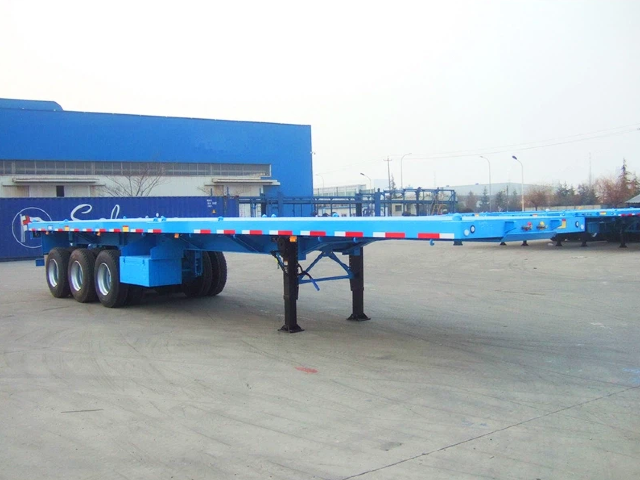
A well-designed flatbed provides evenly spaced stake pockets, strong rub rails, and accessible lashing points.
Poor layout complicates securement and increases hardware stress.
GDSS Trailer integrates securement-friendly structural layouts in its flatbed designs, making heavy cargo positioning more efficient.
When Twist Locks Reduce Workload
Container transport requires secure locking systems. Integrated twist locks reduce the need for additional straps and simplify inspection procedures.
Our 4-axle 45ft container flatbed model is engineered specifically for secure container transport.
GDSS Trailer, established in 2009, operates as a professional trailer designer and manufacturer. With its export office in Qingdao and production facility in Jining, certified as a qualified world manufacturer of trailers, the company employs over 200 staff members including experienced engineers and skilled technical workers. This manufacturing capability ensures durable structures that support reliable cargo securement.
Conclusion
Reducing risk and rework in heavy transport is not about adding more straps; it is about correct contact, proper hardware, realistic angles, and consistent inspections. When applied systematically, flatbed trailer cargo securement becomes predictable and efficient rather than stressful and reactive. Strong structural design, properly positioned anchor points, and secure locking systems all support safer heavy freight restraint on flatbed equipment.
If you are planning a heavy or irregular load, contact GDSS Trailer today to discuss the most suitable flatbed configuration for your cargo profile and improve your cargo securement performance from the foundation up.
FAQ
1. What is the most common mistake in flatbed cargo securement?
The most common mistake is failing to protect straps from sharp edges, which leads to premature strap failure.
2. How many tie-downs do I need for heavy equipment?
The minimum depends on cargo length and weight, but heavier or high center-of-gravity loads often require more than the baseline rule.
3. Why is WLL important in cargo securement rules?
Working Load Limit ensures tie-down hardware has sufficient rated strength to restrain cargo safely during braking and turning.
4. Do twist locks replace straps for container transport?
Twist locks secure containers directly to the trailer, reducing reliance on straps, but inspection and verification remain essential.


